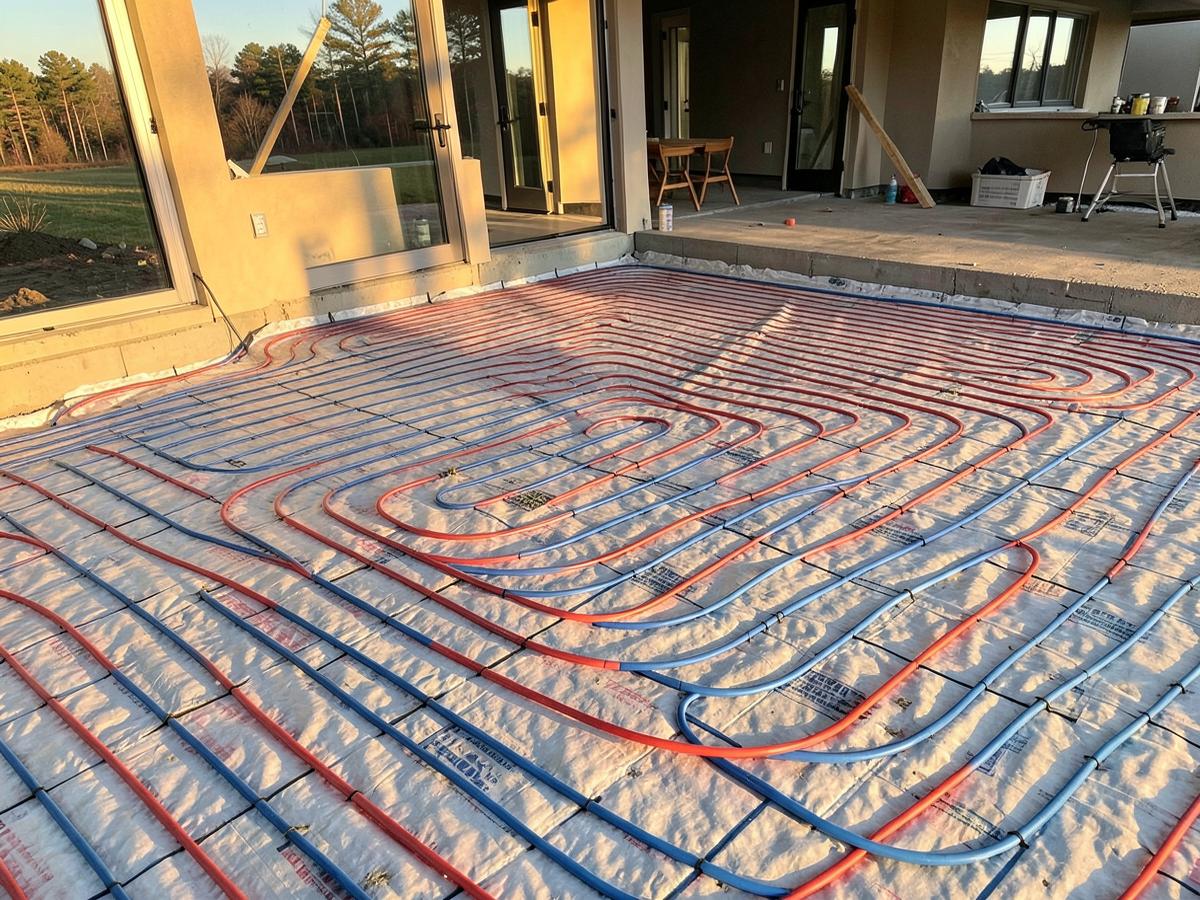
Warmth that starts underfoot.
In-floor radiant heating designed loop by loop, so surface temperatures stay even and the system disappears into the building.
Radiant floors heat objects and surfaces rather than blowing warm air across a room. The result is a gentle, consistent warmth with no drafts, no registers and no visible equipment — particularly noticeable in bathrooms, basements, entries and open-plan living areas.
Performance depends on the details below the finish: insulation, tube spacing, loop lengths, floor covering resistance, manifold layout and water temperature. We design those around each floor assembly and coordinate the installation with the trades pouring and finishing above it.
What a properly engineered system delivers
Even, draft-free heat
Heat rises from the whole floor plane instead of a handful of supply registers.
Invisible system
No radiators or floor registers to design around — the mechanical layer stays hidden.
Low-temperature efficiency
Radiant loops run at low water temperatures, which suits condensing and heat-pump sources.
Room-level control
Each zone holds its own setpoint, so bathrooms and basements can differ from the rest of the house.
- Slab-on-grade and basement floors
- Suspended floors over joists
- Bathroom, ensuite and mudroom comfort zones
- Whole-home radiant in new construction
- Renovation retrofits within floor build-ups
- Garage, workshop and studio heating
Assessment
We review the building, the existing system and how the space is used, then confirm what the project actually requires.
Design
Loads are calculated and equipment, distribution, zoning and controls are selected to match the building.
Installation
Work is executed to the drawing with clean routing, correct clearances and coordination with other trades.
Commissioning
The system is started, measured and adjusted, and we walk you through operation and maintenance.
Frequently asked
Does in-floor heating work under any flooring?+
Most finishes work; each has a different thermal resistance, which we account for in the design so surface temperatures land where they should.
Is radiant heat slow to respond?+
A slab holds heat, so it responds gradually by nature. Controls and outdoor reset are used to anticipate rather than chase demand.
Can radiant be added during a renovation?+
Often, yes, where the floor build-up allows. We assess the assembly and heights before recommending an approach.
Let's build your comfort system.
Tell us about your project — new build, renovation, replacement or service — and we'll take it from there.